
Search
To inform the design of a United Kingdom (UK) paediatric teleotology pilot by analysing global teleotology initiatives and drawing on insights from a successful paediatric teleotology pilot service in Perth, Western Australia (Ear Portal).
The present study aims to investigate the association between an early history of recurrent otitis media (OM) with or without ventilation tube insertion and later behavioural problems in childhood and adolescence.
The aim of this research note is to encourage child language researchers and clinicians to give careful consideration to the use of domain-specific tests as a proxy for language; particularly in the context of large-scale studies and for the identification of language disorder in clinical practice.
Shortage of ear, nose, and throat specialists in public hospitals can result in delays in the detection and management of otitis media. This study introduced a new hospital-based telehealth service, named the Ear Portal, and investigated its role in improving access to specialist care.
A telehealth-facilitated randomised-controlled trial utilising a health promotion intervention to resolve otitis media with effusion for children won specialist Ear, Nose and Throat (ENT) waiting lists
Otitis media with effusion (OME) affects hearing, speech development, and quality of life (QoL) in children. The 'Blow, Breathe, Cough' (BBC) intervention promotes nasal, respiratory, and middle ear clearance through nose blowing, deep breathing, coughing, and hand hygiene. It shows promise in resolving OME but lacks randomized-controlled trial (RCT) evaluation. This paper presents a RCT protocol evaluating BBC's effect on OME resolution, hearing, speech, and QoL in children aged two to seven years.
Melinda Edmunds BSc Program Manager, Ear and Hearing Health Melinda.Edmunds@thekids.org.au Program Manager Melinda is the Program Manager of the Ear

Check out our top tips for travelling with an ear infection so that the kids can fly safely and hit the pool in no time.
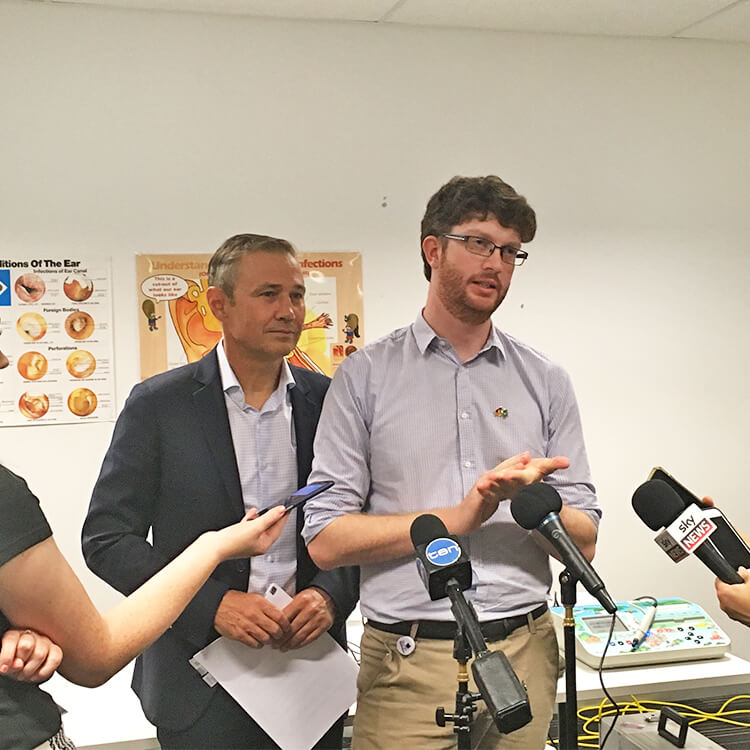
Wait times for Aboriginal children suffering ear infections could be reduced to less than four weeks thanks to a new The Kids Research Institute Australia research project
This study sought to determine the prevalence of Developmental Language Disorder (DLD) in Australian school-aged children and associated potential risk factors for DLD at 10 years.