
Search

An audit of outdoor food advertising near Perth schools has found that three-quarters of the promotions were for junk food and alcohol.
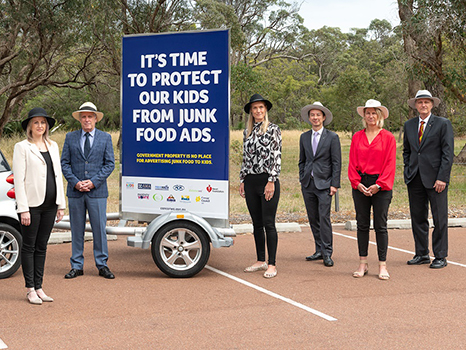
WA’s leading health agencies have joined forces to call on the State Government to immediately end junk food advertising on government property.

A The Kids Research Institute Australia researcher will map every food business and school in Perth to investigate the influence of the food environment on children’s food intake and health.
Preventing the rise in obesity is a global public health priority. Neighbourhood environments can help or undermine people's efforts to manage their weight, depending on availability of nutritious and nutrient-poor 'discretionary' foods. The proportion of household food budgets spent on eating outside the home is increasing. To inform nutrition policy at a local level, an objective assessment of the nutritional quality of foods and beverages on food service menus that is context-specific is needed.
Omega fatty acids are essential for young children’s growth and development. They also have essential functions in cell receptors of membranes and regulation of hormones synthesis. Essential fatty acids such as omega-3 and -6 can only be obtained through food mainly fish and other seafood and to a lesser extent through nuts, seeds, and plant oils.
Energy drinks (EDs) are not recommended for minors' consumption due to a myriad of health risks, but marketing initiatives persist. This study explored the promotion of EDs on TikTok, a platform frequented by children and adolescents.
Locating fast-food outlets near schools is a potential public health risk to schoolchildren, given the easy access and repeated exposure to energy-dense, nutrient-poor foods they provide. Fast-food outlet availability near schools has not been previously investigated in Perth, Western Australia. This study aimed to quantify fast-food outlet availability near Perth schools and determine whether differences in area-level disadvantage and school type exist.
To evaluate whether probiotic supplementation attenuates gut-dysbiosis in neonates with congenital gastrointestinal surgical conditions.
Docosahexaenoic acid (DHA) is a component of neural tissue. Because its accretion into the brain is greatest during the final trimester of pregnancy, infants born before 29 weeks' gestation do not receive the normal supply of DHA. The effect of this deficiency on subsequent cognitive development is not well understood.
There are limited methods to assess how dietary patterns adhere to a healthy and sustainable diet. The aim of this study was to develop a theoretically derived Healthy and Sustainable Diet Index.