Skip to content
The Kids Research Institute Australia logo
Donate

No results yet

Search

Research

Small macrophages are present in early childhood respiratory disease

Recently, an established "small macrophage" phenotype has been observed in the sputum of patients with CF and COPD. However, little is known about the...

News & Events

Phage power: Researchers awarded fellowships to tackle cystic fibrosis infections

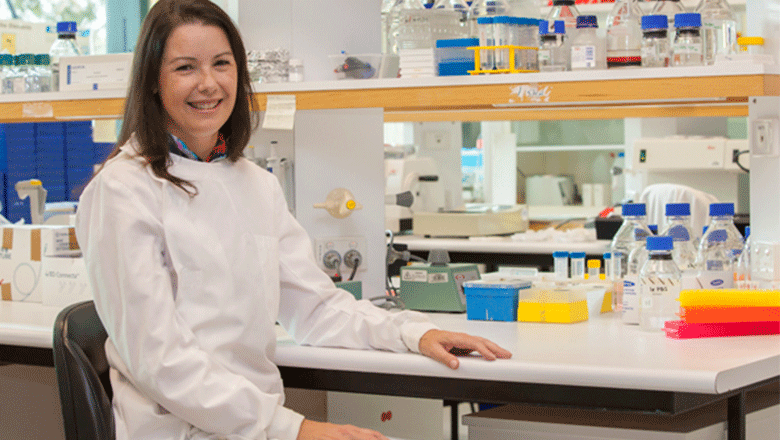
Two researchers from The Kids Research Institute Australia’s Wal-yan Respiratory Research Centre have secured lucrative fellowships to advance cutting-edge phage therapy research for people living with cystic fibrosis (CF).

Research

Substrate-dependent metabolomic signatures of myeloperoxidase activity in airway epithelial cells: Implications for early cystic fibrosis lung disease

Myeloperoxidase is released by neutrophils in inflamed tissues. MPO oxidizes chloride, bromide, and thiocyanate to produce hypochlorous acid, hypobromous acid, and hypothiocyanous acid, respectively. These oxidants are toxic to pathogens, but may also react with host cells to elicit biological activity and potential toxicity. In cystic fibrosis and related diseases, increased neutrophil inflammation leads to increased airway MPO and airway epithelial cell exposure to its oxidants.

Giving kids with CF a chance at a longer, healthier life

COMBAT CF is one of two long-standing international trials which have resulted in new early intervention options helping to reduce progressive lung damage in kids living with CF.

Research

Phage therapy to treat cystic fibrosis Burkholderia cepacia complex lung infections: perspectives and challengesge

Burkholderia cepacia complex is a cause of serious lung infections in people with cystic fibrosis, exhibiting extremely high levels of antimicrobial resistance. These infections are difficult to treat and are associated with high morbidity and mortality. 

News & Events

Watershed approach to improve cystic fibrosis treatment

The Kids researchers are pioneering an exciting new approach to clinical trials, which aims to fast-track the best treatments for people with rare and complex diseases.

Research

Outcomes and endpoints reported in studies of pulmonary exacerbations in people with cystic fibrosis: A systematic review

There is no consensus about which outcomes should be evaluated in studies of pulmonary exacerbations in people with cystic fibrosis (CF). Outcomes used for evaluation should be meaningful; that is, they should capture how people feel, function or survive and be acknowledged as important to people with CF, or should be reliable surrogates of those outcomes. We aimed to summarise the outcomes and corresponding endpoints which have been reported in studies of pulmonary exacerbations, and to identify those which are most likely to be meaningful.

Research

The association between Staphylococcus aureus and subsequent bronchiectasis in children with cystic fibrosis

De novo S. aureus acquisition at age 3 is associated with later bronchiectasis and FEF25-75 in children with CF

Research

Discrete choice experiment to evaluate preferences of patients with cystic fibrosis among alternative treatment-related health outcomes: A protocol

The aim of this study is to identify and quantify the preferences of patients with cystic fibrosis regarding treatment outcomes

Research

CF derived scoring systems do not fully describe the range of structural changes seen on CT scans in PCD

Structural changes identified on CT scans in primary ciliary dyskinesia are not identical to those previously described in cystic fibrosis patients