
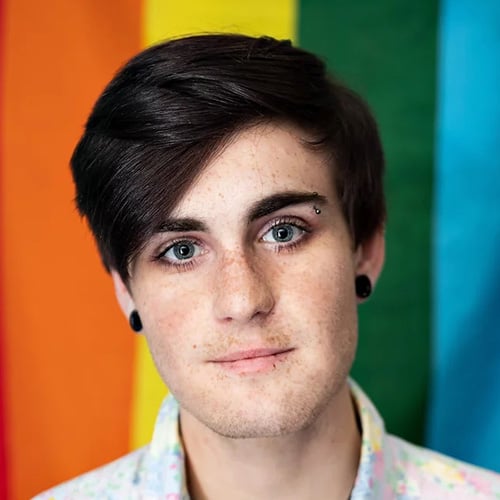
Kai Schweizer
Research Assistant; PhD Candidate
BA, MSexol
kai.schweizer@thekids.org.au
they/he
Kai Schweizer is a researcher, sexologist, and youth worker, and PhD student with the University of Western Australia and The Kids Research Institute Australia. They are also a Research Affiliate at the Inside Out Institute for Eating Disorders, where they are involved in a large study of the body image, eating behaviours of LGBTIQA+ people. Kai’s PhD project is focused on improving eating disorder treatment for trans and gender diverse people.
Their other research interests include:
- The needs and experiences Autistic trans and gender diverse people
- Causes for the high prevalence of chronic pain and chronic health conditions in trans and gender diverse people
- The impact of Autism and ADHD on eating and exercise behaviours
- Trans and gender diverse sexual health
Published research
Disordered eating in autistic trans and gender diverse people: a lived experience-led scoping review
This lived experience-led scoping review explores the evidence base related to eating disorders/disordered eating behaviours in Autistic trans and gender diverse (TGD) people. This review highlights the currently available data on eating disorder prevalence rates, comparisons with allistic and cisgender groups, drivers and maintenance factors, the relationship between eating disorders and gender-affirming medical care, and treatment outcomes in this population.
The Costs and Benefits of ‘Passing’: A Systematic Review of the Qualitative Evidence on Passing for Trans Individuals and Communities
Passing is a contentious issue within the trans community. Some trans people strive to pass as cisgender as an inherent goal or to reduce dysphoria, enhance safety, and potentially to facilitate acceptance. Others argue that trans people should not need to pass and that expectations to do so can cause harm to the trans community. This review aimed to systematically source and synthesize the existing qualitative literature that explores the costs and benefits of passing for trans people.
Physical activity behaviors in trans and gender diverse adults: a scoping review
There is currently limited data regarding the physical activity behaviors of trans and gender diverse people (including binary and non-binary identities; henceforth trans). The aim of this review was to synthesize the existing literature in this area, with a focus on physical activity behaviors as they relate to health (e.g. health benefits, risks of adverse health outcomes).
Eating and exercise experiences of Australian trans and gender diverse folks: lived experience and stakeholder perspectives
Trans individuals face elevated health risks and socio-environmental challenges, influencing their engagement in health-protective behaviors (e.g. exercise and nutrition). Despite these challenges, there is a significant gap in understanding the specific eating and exercise experiences of Australian trans adults, including barriers to healthy behaviors and healthcare experiences. This study aims to address this gap by exploring these experiences, informing targeted interventions and healthcare practices to improve health outcomes.
Neurodivergence, intersectionality, and eating disorders: a lived experience-led narrative review
Autistic people and those with attention deficit hyperactivity disorder are at a high risk of developing an eating disorder. While there is limited evidence on the relationship between other forms of neurodivergence and eating disorders, research suggests associations between giftedness, intellectual disability, obsessive-compulsive disorder, psychosis, Tourette's syndrome, and disordered eating.
A scoping review of trans and gender diverse children and adolescents’ experiences of physical activity, sport, and exercise participation
This study investigated the potential of using SARS-CoV-2 viral Increasing young people's physical activity, along with their motivation and confidence to be active, is widely advocated for supporting desirable health outcomes. Trans and gender diverse (henceforth; trans) young people experience significant physical activity-related barriers compared to cisgender (i.e., an individual for whom gender identity and sex presumed at birth are in alignment) peers.
Education and Qualifications
- Bachelor of Arts – Curtin University
- Graduate Diploma in Sexology – Curtin University
- Master of Sexology – Curtin University
Awards/Honours
- 2021 - Rosemary Coates Sexology Award
- 2021 - LotteryWest Award for LGBTI Inclusion
- 2018 - Pinnacle Scholarship